Why the Spiritual Industry Needs a Threat Model: you cannot defend what you cannot model — and this terrain was mapped by attackers first
The capstone of this wave: the root causes that make the spiritual market ideal cognitive-warfare terrain, the pattern family already documented running on it, and the layered model that turns scattered symptoms into a defensible map.
Executive Summary: the patterns are documented and the terrain is mapped — what has been missing is the model that connects them
The first two reports in this series documented two running patterns: sincere creators serving as relay infrastructure in cognitive campaigns (The Compromised Host), and high-price collective systems harvesting their members while delivering genuinely real returns (The Guru Retreat as a Container Trap). This report supplies the piece both of them stand on: why this market keeps producing patterns of exactly this shape, and the structural model that makes them visible before they finish running.
- The market’s defining features are also its attack surface. Trust by design, unverifiable sources as a content norm, altered states of heightened suggestibility, deep identity investment — remove these and the practice dies; leave them undefended and they are ideal campaign terrain. Defence has to model them, not patch them away.
- State-level interest in this terrain is documented history, not speculation. Declassified intelligence programmes engaged the psychic domain for decades, and current cognitive-warfare doctrine formalises the mind as an operational domain — the attackers’ side has been mapping this ground far longer than the market has.
- The documented patterns are one family, not isolated scams. Relay recruitment, the harvest loop, and the container trap each exploit the same structural condition at a different layer of the system; fought one at a time, at the surface, they regenerate.
- A threat model turns symptoms into locations. The Consciousness Virtualisation Platform (CVP) maps a spiritual system as layered infrastructure: every documented pattern becomes locatable at a layer, and every layer gets an inspection point with a matching open-source instrument.
A firewall without a network topology is just a filter with opinions; a threat score without a structural model is just a number. The rest of this report walks the terrain in that order — why this ground, what runs on it, and the map that makes it defensible.
Situation: the industry was never neutral ground — its structural features made it operationally interesting from the start
Ask why the spiritual and psychic market keeps appearing in analyses of cognitive conflict and the answer is structural, not moral. Four features define the market — and each one doubles as an exploitable condition:
| Defining feature | Why the practice needs it | What it offers an operator |
|---|---|---|
| Trust by design | Openness and vulnerability are inherent to genuine practice | A pre-built channel that bypasses scepticism |
| Unverifiable sources as a norm | Teachings reference realms where standard verification cannot follow | Authority becomes self-referential — payloads cannot be source-checked |
| Altered states | Meditation, breathwork, and ceremony are the practice | Heightened suggestibility; content can bypass critical faculties |
| Identity investment | Belief and practice anchor who the practitioner is | Questioning the channel becomes psychologically expensive |
None of these is a flaw to fix. A spiritual market without trust, mystery, depth of experience, or commitment is not a spiritual market. That is precisely why this terrain needs a threat model rather than a purge: the features must be defended as terrain, because they cannot be removed without destroying what they serve.
And the operational interest in this terrain is not new. Declassified files show that United States intelligence agencies funded remote-viewing and psychic research for roughly two decades before the programme’s closure in 1995 — whatever one concludes about the results, the institutional attention is public record. The modern formalisation is more direct: a NATO-sponsored study (du Cluzel, 2020, Cognitive Warfare, NATO Innovation Hub) names the brain “the battlefield of the 21st century”, and peer-reviewed work now specifies how campaigns in that battlespace are actually built. The overlap between intelligence work and the spiritual domain is old; what changed is that the methods became doctrine — and that generative AI gave the market a propagation layer with no fact-checking above it.
The asymmetry, then, is this: one side of this conflict has been surveying the terrain for decades and now publishes its doctrine, while the market operating on the terrain still evaluates threats one guru, one scandal, one debunking at a time.
Analysis: three documented patterns, one structural condition — a market that cannot inspect what it transmits
Set the two previous reports side by side with the message-level markers our tooling detects, and the pattern family becomes visible:
| Pattern | Where it operates | What it exploits | Documented in |
|---|---|---|---|
| Relay recruitment | The information environment around a creator | Trust plus the absence of any verification gate between inbox and output | The Compromised Host |
| Harvest loop | Between a collective system and its members | Commitment devices and redistribution presented as teaching results | The Guru Retreat |
| Container trap | The social container itself | A deep hook committed during an engineered emotional peak; benefits gated on continued payment | The Guru Retreat |
| Message-level stack | Individual pieces of content | Urgency, borrowed authority, emotional manipulation, commitment escalation | Detection dimensions |
Four rows, one condition: every pattern runs through layers its host cannot inspect. The relay creator cannot see the campaign shape their content serves. The retreat member cannot see which layer their returns come from. The reader cannot see where a claim originates. In each case the exploited person is operating inside the system, and the pattern is only visible from a structural vantage point they do not have.
That vantage point is what a threat model provides — and it is why we built one instead of another detector. The Consciousness Virtualisation Platform models a spiritual system with the same layered architecture used for virtualised infrastructure, because the structural properties — layer independence, container isolation, signal routing, and the gap between what a system is and what it thinks it is — are identical. In plain terms, the stack runs from a foundation axiom (consciousness is not reducible to the mind), up through the body, the deep collective patterns and tradition templates a person inherits, the information environment that decides what reaches them, the individual mind doing its in-process work, and finally the social container that constrains all of it. The full seven-layer model, with its infrastructure analogues, lives in the open documentation — this report only needs the map it produces:
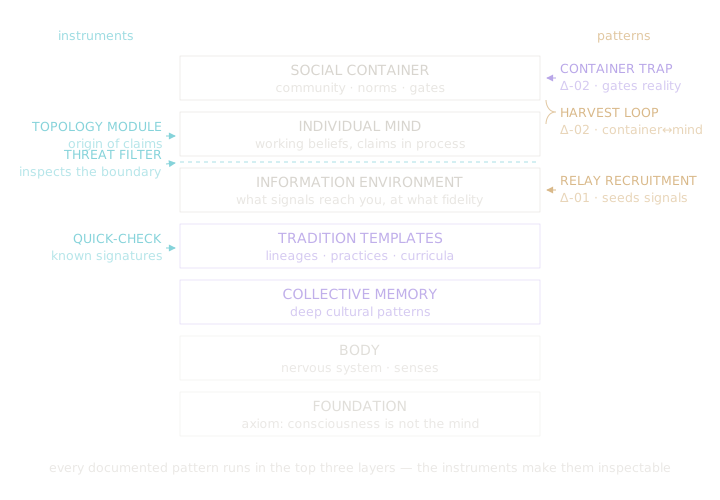
Read the map and the family resemblance stops being a coincidence: every documented pattern operates in the top three layers — container, mind, information environment — the layers where collective systems can write, signals can be shaped, and inspection is absent by default. The deep layers hold what the patterns imitate; the shallow layers are where they run.
Evaluation: a model converts detection from opinion into topology — and shows why the deep interventions pay
What does the model actually buy, beyond a diagram? Three things.
It aims the instruments. Each open-source tool in SI Protocols inspects a specific layer, and the model is what says which — a threat score without that placement is just a number:
| Instrument | Layer it inspects | Question it answers |
|---|---|---|
| Threat filter | The boundary into the mind | How much manipulation does this text carry? |
| Topology module | The mind’s claims in process | What is actually claimed, and from which layer does it originate? |
| Quick-Check skill | Tradition templates and container signatures | Does this text match known structural patterns? |
This is also why the topology module refuses a binary verdict and classifies claims as PSEUDO, TRUE, or INDETERMINATE: a text is not uniformly manipulative or uniformly genuine — it is a mix of container artefacts, deep patterns, and in-process claims, and only a layered model can say which is which.
It derives diagnostics instead of collecting anecdotes. The two tests from The Guru Retreat — the price-gate test and the non-contributor test — are one model question in two forms: which layer are the benefits coming from? The five outbound questions from The Compromised Host are boundary inspection at the one gate a creator fully controls. Neither report needed to allege bad faith anywhere, because structural diagnostics do not require intent — that is what makes them usable in a market where intent is unfalsifiable and outcomes are genuinely positive.
It ranks the interventions. The leverage-tier map published in The Compromised Host applies across the whole terrain: debunking a single post is surface-tier effort against an architecture that regenerates, while the paying interventions sit at the structural and architectural tiers — the reinforcing loops, the acceptance gates, and ultimately the authorship question over one’s own deep patterns. The threat model is what tells you which tier a given symptom belongs to, so effort lands where the system actually bends.
For the reader, the value compresses to one word: location. Knowing which layer you are looking at explains where you are, why the suffering traces deeper than the events that express it, and which effort is worth your finite attention. No awakening is announced here — a map is handed over.
Recommendation: adopt the four questions, locate yourself on the map, and run the instruments locally
Threat modelling is a practice, not a purchase. It asks four questions, and in this terrain they have concrete answers:
- What are we protecting? Autonomy, financial wellbeing, psychological health, and the freedom to form genuine spiritual connections — the deep layers of the stack.
- What could go wrong? The documented family: relay recruitment, harvest loops, container traps, and the message-level stack that feeds them.
- Who might cause harm? Mostly nobody you could name — the previous two reports show the dominant patterns running on sincere participants and emergent collective logic, no villain required.
- What can we do about it? Model the terrain, inspect the boundaries, and intervene at the tiers where leverage lives.
Then locate yourself, using the wave you have just read. If you produce content, run the outbound gate from The Compromised Host before anything ships — it is the boundary inspection this model says pays most. If you are inside a paid collective system, run the four location questions from The Guru Retreat — they are the container audit. If you are evaluating content or teachers, run the instruments themselves: they are local-only, open-source, and free, which is not a distribution choice but a security property — a detection layer you cannot inspect is one more unverifiable authority, and this terrain has enough of those.
The market will keep telling you the time has come and that you have been chosen. A threat model tells you something more useful: where you are standing, what is running there, and which way is out. Proportionate response, not paranoia — that shift, from intuition to informed awareness, is the core of spiritual intelligence.
We analyse structure, not people. The historical programmes cited are declassified public record; every market pattern in this report is a pattern class drawn across the sector. Specific organisations, teachers, and platforms exist in the wild, but the patterns are what we examine. The patterns are the artefact.