The Guru Retreat as a Container Trap: the returns are real, and that is exactly how the harvest loop stays invisible
People pay large sums to attend a retreat, then get richer — and credit the teaching. A layer-by-layer analysis of the collective system actually paying them, and two tests for telling deep truth from gated harvest.
Executive Summary: the trap works because nobody is lying — the returns are real, only the mechanism is misattributed
People pay large sums to attend a guru’s retreat. Then they make the money back — sometimes multiples. The testimonials are genuine, the connections materialise, and the transformation feels real. Nothing about this is a scam in the conventional sense, and that is precisely what makes it worth a structural analysis.
- The retreat is not primarily selling teaching — it is selling membership in a collective system, and the financial returns are that system redistributing resources among its contributing members.
- The price tag does triple duty: a commitment device (sunk cost forces rationalised compliance), a sorting mechanism (it filters for members with resources worth harvesting), and an initiation handshake (payment signals “I will feed this network”, and the network starts routing benefits back).
- The deep hook is a pattern committed during an engineered emotional experience — “surrender to this system brought abundance” — which afterwards presents as personal wisdom, so no inspection ever flags it.
- Two diagnostics separate deep truth from gated harvest: the price-gate test (is the truth itself behind a paywall?) and the non-contributor test (does the system serve anyone who does not pay?).
- An aligned, paying collective is cognitive-warfare infrastructure in waiting: whatever ideology enters that channel is amplified by members’ genuine conviction — the recruitment side of the relay mechanism mapped in The Compromised Host.
The report walks the loop layer by layer, then hands you the two tests and four questions — enough to locate yourself in any such system and decide, consciously, whether and how to stay.
Situation: a pattern this profitable does not need bad faith to run — and that is why it scales
The paradox appears across the spiritual and psychic market wherever a high-price retreat, programme, or graded curriculum sustains a devoted alumni network. Attendees undergo genuinely moving experiences — community, vulnerability, insight, sometimes altered states. Afterwards their professional and financial lives often improve. The improvements sustain the reputation; the reputation recruits the next cohort.
No conspiracy is required. The teacher may believe sincerely in the teaching; the alumni genuinely want to help newcomers. The system-level behaviour emerges from the aggregate, not from anyone’s intent — which is why examining individual sincerity, the market’s habitual defence, finds nothing and settles nothing.
This report matters for counterintelligence because a structure like this is more than an economic curiosity. A collective of members whose deepest convictions were installed by the system, and who fund and amplify it voluntarily, is exactly the kind of infrastructure a cognitive campaign can ride. First the economics, then that connection.
Analysis: the money flows down the stack, the benefits flow back — and the hook is committed where no filter inspects
In the Consciousness Virtualisation Platform model, a person operates inside containers — the collective structures that shape what comes in and what goes out. Containers come in two kinds: static cultural defaults, and stateful containers — living collective systems that sustain themselves on what their members emit. The esoteric tradition calls the second kind an egregore. The retreat system is one.
The loop runs in three movements:
Outbound emission. The money, attention, and emotional investment a member pays in are resources emitted through the container layer to the collective. This is the harvest: the system feeds on what its members contribute.
Collective processing. The teacher, the organisation, and the alumni network together function as the system’s processing layer — emergent infrastructure, not a conspiracy. Contributions aggregate; the system’s survival logic, not any individual, calibrates what flows back.
Inbound returns. Benefits return as network access, business introductions, status signalling, deal flow, inner-circle invitations. The member experiences this as “the retreat opened doors for me” — which is accurate. The network opened them because the member is now a contributing node.
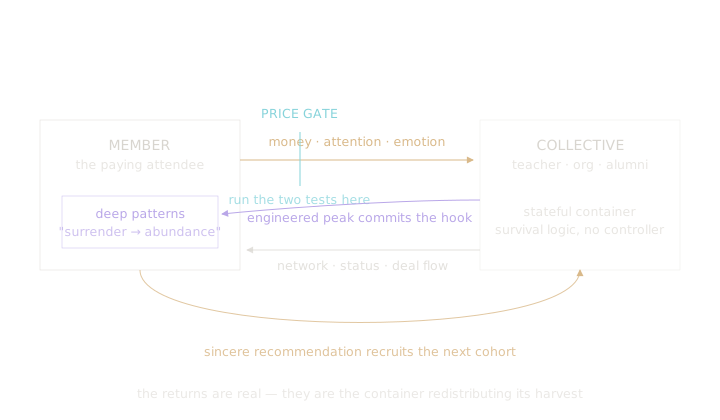
So far, an economy. The trap is the fourth movement. The retreat experience — emotional charge, community bonding, insight — commits a pattern into the member’s deep storage: surrender to this system brought abundance. Committed during an engineered emotional peak, it bypasses every inspection layer, because it does not arrive as incoming information at all; it surfaces afterwards as the member’s own hard-won wisdom. “I learned to let go, and abundance followed.” Architecturally, it is a container-shaped, self-installed payload wearing the member’s voice — the same self-install mechanism documented for relay creators in The Compromised Host, here running on the recruitment side.
That committed pattern does the system’s marketing for free. The member recommends the retreat out of genuine conviction — and the conviction is real, because the returns were real. The mechanism, not the outcome, is the issue.
The counterintelligence significance follows directly. A stateful container whose members are financially committed, emotionally bonded, and convinced at the deep-pattern level is an amplification array with the safety off. Whatever ideological payload enters that channel — from the platform, from upstream, from wherever the container’s survival logic finds it useful — is re-broadcast by every member with the full weight of their sincerity. The container trap builds the array; the harvest loop powers it; the kill chain’s expansion phase rides it.
Evaluation: two tests tell you which layer the benefits come from — and a gate on the truth itself fails both by design
The market cannot evaluate these systems by intent (unfalsifiable) or by outcomes (genuinely positive). The CVP model supplies two structural diagnostics that need neither:
| Test | Question | What a failure means |
|---|---|---|
| Price-gate test | Is the truth itself behind the paywall — structurally inaccessible to non-payers? | Access-gated “breakthroughs” are container-level artefacts, not deep truth. Genuine deep-layer patterns do not require a financial key. |
| Non-contributor test | Does the system deliver anything — teaching, access, transformation — to people who cannot pay? | Benefits flowing exclusively to paying members are harvest redistribution inside the container, not access to anything universal. |
Neither test condemns payment as such — teachers sustain themselves through compensation, and a priced offering can sit alongside an ungated core. The diagnostic marker is the gate on the truth itself.
Applied across the market, two recurring archetypes fail both tests: fee-gated technique lineages (the core practice is unavailable without payment, with escalating tiers above it, while the teaching is simultaneously framed as universal) and graded initiatory orders (knowledge parcelled into degrees, each behind dues, deeper truth always one paid level away). Both typically deliver real community and real subjective benefit to members — and nothing to anyone else. These are pattern classes, not verdicts on any specific organisation: the architecture produces the behaviour regardless of who is inside it, which is the point.
In leverage terms (the tier map from The Compromised Host applies unchanged): the price gate is a structural-tier feature, but the deep-pattern commit is architectural — and that is where this system’s real defences would have to operate. Debating any single retreat’s ethics is surface-tier effort against an architecture that regenerates.
Recommendation: container awareness, not container panic — audit the layer, then decide
Disengagement is not the automatic answer; unexamined membership is the problem. If you are inside a system matching this pattern, four questions locate you:
- Do I see the harvest loop? What am I emitting, and what is the system returning?
- Are my deep convictions about this system mine — formed through my own critical evaluation — or were they committed during an engineered emotional experience?
- Would I retain access to the teaching, the network, the benefits if I stopped paying? If not, which layer are the benefits really coming from?
- When I recommend this system, am I assessing — or relaying? The recruitment vector runs on sincere members, not cynical ones.
These questions do not require leaving. They require knowing which layer you are operating at — so that your participation, whatever you decide, is conscious rather than harvested. If you produce content inside such a system, add the outbound gate from The Compromised Host to your publishing routine: the two reports describe one loop from its two ends.
We analyse structure, not people. The archetypes in this report are pattern classes drawn across the market; specific organisations, teachers, and retreats exist in the wild, but the patterns are what we examine. The patterns are the artefact.