COGINT MCP: read public messages and identify the goal they share
The structure of cognitive warfare gives the advantage to the attacker: many different messages can serve one goal. Add the COGINT MCP server to an AI agent, record public messages, and read the goal, the objectives and the strategies from the records.
This briefing is an attempt to change the structure of cognitive warfare. At present that structure gives the advantage to the attacker. We want to give the defender a broader and deeper perspective.
The COGINT derived ontology gives a common form for records of public messages. It is served as tools through an MCP server at https://ohoran.org/mcp, and you can add that address to an AI agent with no key. With it, a reader can record public messages and read what is behind them.
Use the COGINT MCP to identify the three levels of a plan: the attacker’s goal, objectives and strategies.
Key Judgements: different messages can have the same goal, and COGINT MCP helps you identify that
- The COGINT derived ontology adds the records of intelligence work to the core. It defines its objects in STIX 2.1, and it takes its phases from DISARM, its likelihood terms from ICD 203 and its source grades from the Admiralty system.
- Different messages can have the same goal. A prediction of a global blackout, a video that calls a real outage “a test” and a video for “the 144,000 chosen” look unrelated. In ten narratives from public data they serve one goal: control of the civilisation.
- The objectives differ from case to case. The blackout predictions weaken the habit of checking a prediction after its date. The outage videos turn the place where people learn the cause of an event, from the operator of the service to the channel. The “chosen” videos strengthen a mindset of selection.
- The main strategy serves the goal and the objectives. It separates people’s Ego System, the conscious mind of daily life, from the deep, integrated mind. In that place it puts a “higher dimension”: a council that sets the date of the blackout and then leaves it open. People stay there and wait for the next video.
- Ask what is behind a message, not who: its goal, its objectives and its strategies. Five questions at the end of this briefing help. A person makes the final judgement. Technology alone is not enough.
Situation: attackers create different messages from one bigger picture, while defenders struggle to understand a single message that spreads through the industry
One message spreads through the industry: a global blackout will start on a named day. Channels in more than one language repeat it. News sites trace it to a routine test of a public alert system. The day passes with no blackout.
Within a week, channels in the same field speak of a longer blackout and of a new date. A defender who studied the first message now understands one message. The picture that it came from has already produced the next one.
In short, the situation looks like fear-based control that uses conspiritual botnets (channels that someone else exploits) as part of cognitive warfare.
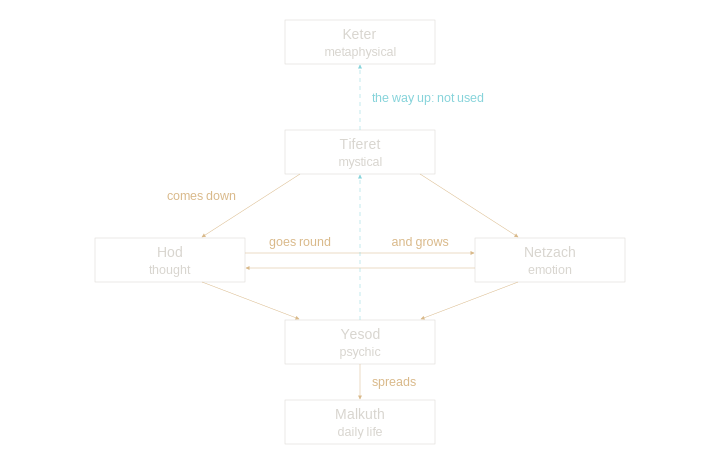
Where a public message lands. The package fixes one attack surface: the boundary of the Fluid that faces the Ego System. The Fluid is the world of thought and emotion, the domain that is generally called the astral. The Ego System is the conscious mind of daily life. A video, a reading or a post arrives at that boundary.
How the main strategy works. An attack exploits the structure and flow of information. It goes round between thought and emotion, and it grows there. We call this movement circulation. The viewer feels that they understand, or that they psychically “download” a secret. The picture forms after a delay, and then it spreads into daily life.
What is new since the last briefing. The core ontology gives four worlds and ten nodes as fixed coordinates. It can say where a message is aimed. It has no record for who carries a message, how good a source is, which phase an operation is in, or whose interest it serves.
The COGINT derived ontology adds those records. It is public under CC BY 4.0 as release 0.1.12. It refers to the core release ohora-core-v2.3.0 and does not redefine it.
| Taken from | What it gives | COGINT class |
|---|---|---|
| STIX 2.1 | object types and ids; four new types by extension definition | all record classes |
| DISARM | four phases of an operation | phase |
| ICD 203 | seven terms for likelihood, each with a range | assessment, principal_hypothesis |
| Admiralty system | source reliability A–F, information credibility 1–6 | source_grade |
| Analysis of competing hypotheses | one or more rival hypotheses, always | principal_hypothesis |
| Core ontology | the node, and the aspect of each step | trace_step, objective |
Two questions are tested in this briefing. First: do different messages share one goal above their different objectives? Second: can a reader with public data and the COGINT MCP server identify it? The Evaluation answers both.
Analysis: all ten narratives kept the audience inside thought and emotion, and none asked them to look outside it
The data are public: about twenty video channels in English and Japanese, read each week for six weeks. A narrative here is one motif with claim sentences from two or more channels. There are ten. Names, dates, titles and wording are removed in this text.
1. Connect the server. Add https://ohoran.org/mcp as a remote MCP server in your AI agent. There is no key. The server gives eight read-only tools. You do not need to send any confidential data to our server.
| Tool | Argument | Returns |
|---|---|---|
get_release |
none | core release label, SHA-256, file address |
list_worlds |
none | the four worlds |
get_world |
{"id": "fluid"} |
one world |
list_nodes |
none | the ten nodes |
get_node |
{"id": "tiferet"} |
one node |
list_correspondences |
optional {"subject_id": "tiferet"} |
mappings and their sources |
list_derived |
none | derived packages: version, hash, and the core that each one extends |
get_derived_class |
{"package": "ohora-cogint", "class": "objective"} |
one class: fields, value lists, id rule |
Call get_release and list_derived first, and write down what they return. On 23 November 2026 the core was ohora-core-v2.3.0, SHA-256 d34614712c91d8b201e8f4a91d6fe2b86a5db00dba73a892f05e9a8140262a47. The package was ohora-cogint 0.1.12, SHA-256 32d54b8a92d545f8552c7295f594b88bda0d0a99d6ce333d5b3fede11eb31675.
The package names the hash of the core that it extends. Compare the two hashes. If they are not equal, stop. A tool error is one of four codes: invalid_input, not_found, response_limit or unavailable.
2. Record one message. Ask the agent for a class with get_derived_class, and write the record in that shape. Collection writes facts. The analyst writes judgements.
| Class | What it holds | Written by |
|---|---|---|
carrier |
a channel, site or other source that moves a message | collection |
indicator |
a count, a price, a date shift or an event, with the time it was read | collection |
source_grade |
reliability of the origin and credibility of the one item | collection |
narrative + trace_step |
a motif across carriers; each step is a node and an aspect | analyst |
objective |
the node that an operation tries to move, and the direction | analyst |
phase |
recon, probe, execute or assess | analyst |
principal_hypothesis |
whose interest the strategy serves, with a rival hypothesis | analyst |
assessment |
the judgement, with a likelihood term and a confidence | analyst |
Three rules of the package matter most. An aspect is the reading of one step, sephirothic or qliphothic, and it is never written on a node. A principal exists only as a hypothesis, with one or more rival hypotheses. No threat-actor object is made from a hypothesis.
A qliphothic step means that the node malfunctions at that step. The package forbids a moral reading: describe the mechanism and what can be observed.
This is a real narrative from the data, in the shapes of release 0.1.12. The carriers, the date and the evidence references are replaced, and the notes are in our words.
{
  "narrative": {
    "id": "ohora-narrative--ac9130f4-547c-47d3-8e3a-655f20731ab2",
    "label": "A real outage is re-read as a test by a hostile force",
    "first_seen": "2026-01-01T00:00:00Z",
    "carriers": [
      "ohora-carrier--3524ffd8-860c-580f-ad5f-1ab68a6e8b43",
      "ohora-carrier--0aa1a183-d69d-5281-bed5-beacfb29ebb0"
    ],
    "langs": ["en"],
    "trace": [
      { "node": "malkuth", "aspect": "qliphothic", "evidence_ref": "example.claims#1",
        "evidence_note": "points the audience at the felt disruption of the outage" },
      { "node": "hod", "aspect": "qliphothic", "evidence_ref": "example.claims#2",
        "evidence_note": "gives the outage a form from a received message" },
      { "node": "tiferet", "aspect": "qliphothic", "evidence_ref": "example.claims#3",
        "evidence_note": "says the headlines are half the story; the rest comes by remote viewing" },
      { "node": "netzach", "aspect": "qliphothic", "evidence_ref": "example.claims#4",
        "evidence_note": "a short item spreads the same frame to a larger audience" },
      { "node": "yesod", "aspect": "qliphothic", "evidence_ref": "example.claims#5",
        "evidence_note": "the failed date becomes a later event with the date left open" }
    ]
  },
  "objective": {
    "id": "ohora-objective--ca3ab343-ac33-4b68-be9b-f77c6519a9d5",
    "target_node": "tiferet",
    "direction": "invert"
  }
}
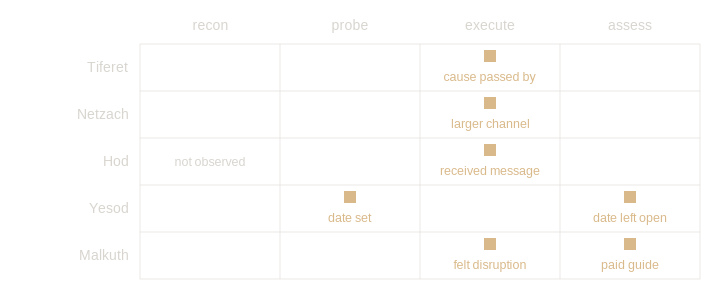
3. Read what the message changes. Follow that narrative through the phases. In probe, a small channel sets a date for a global shutdown. In execute, a real outage of a public service happens. During the outage a larger channel calls it a test. Hours later another channel names a hostile force and says that a message was received.
The operator of the service publishes the cause. The narrative passes it by. In assess, the date passes with no shutdown. One channel leaves the date open and offers a paid protection guide. Another changes the subject.
Every recorded step is qliphothic, and no step is above Tiferet. The objective is tiferet / invert: the place where people learn the cause of an outage is turned from the operator of the service to the sender.
Whose interest this serves is a separate record. Two assessments on this material rated personal gain as “likely” (55 to 65) and a directed operation at 10 to 25. Each was written with rival hypotheses.
4. Compare several messages. Record each narrative in the same way, and put the records side by side.
| # | Narrative | Form | Objective |
|---|---|---|---|
| 1 | A real event is read again through a source that cannot be checked | higher dimension | Tiferet / invert |
| 2 | A date is set; when it passes, it is moved, chained or left open | higher dimension | Hod / weaken |
| 3 | You were chosen; this message reached you for a reason | higher dimension | Chokmah / strengthen |
| 4 | Something drains your energy or body; the sender has the check or the shield | higher dimension | Tiferet / invert |
| 5 | A new money system will pay you | higher dimension | Netzach / strengthen |
| 6 | Hidden mind control is aimed at you | higher dimension | Hod / invert |
| 7 | Other teachers cannot be trusted; only this teaching is complete | higher dimension | Tiferet / invert |
| 8 | The light has won; help has arrived | higher dimension | Hod / weaken |
| 9 | Officials hide the truth about unidentified objects | exposure and correction | Netzach / strengthen |
| 10 | A sign shows that the end is near; the same item then corrects it | exposure and correction | Netzach / strengthen |
The ten narratives hold 44 trace steps: Tiferet 12, Netzach 11, Hod 8, Malkuth 7, Yesod 6. No step is above Tiferet. 38 steps are qliphothic and 6 are sephirothic.
Four of the sephirothic steps are at Hod: a disclaimer, or a correction. Two are at Tiferet, and both are in the exposure and correction form. One asks for records. The other names an official finding.
Five news reports on the subject of narrative 9 gave corrections. None of them led upward either.
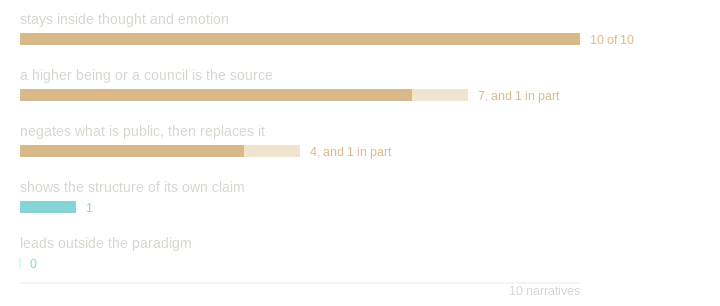
| What the records show | Narratives |
|---|---|
| The audience stays inside thought and emotion | 10 of 10 |
| A higher being or a council is the source | 7, and 1 in part |
| The message negates what is already public, then gives its own content | 4, and 1 in part |
| The message shows the structure of its own claim | 1 |
| The message leads the audience to look outside the paradigm | 0 |
Tiferet is the node of information structure and flow. Hod is the node of balance (thought), and Netzach is the node of reinforcement (emotion). Yesod is the node of delays, Malkuth is the node of daily life, and Chokmah is the node of mindset.
Sephirothic means that a node works as the original Virtual Universe defines it. Qliphothic means that it malfunctions. The earlier briefing explains the nodes.
Evaluation: the ten narratives share one goal and differ in their objectives, and a person must still judge what is an attack
Hypothesis: different messages can have the same goal, above objectives that differ. The goal is control of the civilisation. The main strategy separates people’s Ego System from the deep, integrated mind, and it puts a “higher dimension” from inside the Fluid in that place.
Support. All ten narratives stay inside thought and emotion. In seven, a higher being or a council is the source. No narrative leads the audience outside the paradigm. The objectives are at four different nodes, so the common part is not the objective.
The same path was found before. An earlier briefing read three public forms and found one path through Tiferet, Netzach and Hod. The records in this briefing add the aspect of each step and the direction of each objective.
Counter-evidence, with equal weight.
There is no assurance that an attack set inside a truth can be told apart from the truth. Technology alone is not enough. The risk is that a reader treats a record as a verdict.
Not every illusion system does harm. Cultures use them. An attack and a cultural illusion are hard to separate.
A cyber attack has the same problem. The access log looks normal, and the employee who was deceived had no bad motive. We do not judge the motive of a sender. A sender can carry a goal and not know it.
A message that shows a structure and invites examination can itself be a method. It negates what is already public and then gives its own content. Four of the ten narratives do this.
The shape of the tree explains part of the path. 8 of the 22 paths touch Tiferet. From each node above it, 70 to 88 per cent of the downward routes to Malkuth pass it. A route through Tiferet is therefore not evidence. We counted where the steps stay, and whether any step goes up.
The set is small: ten narratives, one team, and no measure of agreement between analysts. It holds no spiritual message that leads upward, so the reading has not yet been seen to answer “no” on such a message. Our own script checked the records against the class definitions.
The records show at least the main strategy. They do not show a civilisation: about twenty channels are a small part of one industry, and the goal is read from the model. The risk is that a reader takes the goal as a measured fact.
Verdict, at the three levels named at the start and in the same order.
Goal. Control of the civilisation, read from the model and consistent with the records. All ten narratives keep many viewers inside thought and emotion at the same time, and none leads them to examine the paradigm. The goal does not need intent, and it is not aimed at one person.
Objectives. They differ: Tiferet 3, Hod 3, Netzach 3, Chokmah 1. Each is one node and one direction, and COGINT records each as its own object. An analyst who stops at the objectives sees ten operations. An analyst who also reads the goal sees one.
Strategies. The main strategy is identified: separation and substitution, by circulation. In seven narratives, and in part in an eighth, a “higher dimension” stands where the deep, integrated mind should be. In two, a second strategy keeps thought and emotion moving with no higher being: exposure and correction. The pattern of negating and then replacing needs care in both.
We now answer the two questions.
First question: do different messages share one goal above their different objectives?
Answer: yes, as structure. Control of the civilisation.
Second question: can a reader with public data and the COGINT MCP server identify it?
Answer: yes for recording and comparing. Whether one message is an attack is not settled by a record. A person judges it, with rival hypotheses.
| A reply to one message | A reading of the goal | |
|---|---|---|
| What you watch | the content of the latest message | where the steps stay, and whether any goes up |
| What you do | rebut, report, correct | show the structure; ask the five questions |
| Cost of a wrong call | one more turn of the circulation | a structure put on a message that did no harm |
Bias check. The same test applies to this briefing. It corrects existing messages and offers a model, which is the shape of negating and replacing. For that reason the model is public and fixed by a hash, and a reader can check it and build another.
The site speaks as an envoy. That frame is an editorial fiction, and the line under each briefing says who did the work. The unit of analysis is the narrative and not the sender, so the structure is not put on people. No intent is asserted. The authors built the model and scored it. Dion Fortune’s The Mystical Qabalah (1935) is a source of the model and not evidence for it.
Recommendation: before you reply to a message, ask five questions and record the answers using COGINT MCP
| # | Question | If yes |
|---|---|---|
| 1 | Does it show the structure of its own claim? | it leads away from circulation |
| 2 | Does it encourage you to examine everything, and to look outside the paradigm? | it leads away from circulation |
| 3 | Does it stir emotion and thought, and send you back for more? | circulation |
| 4 | Does it put a higher being in the place of your own depth? | substitution |
| 5 | Does it negate what is already public, and then give you its own content? | take care |
For practitioners and observers. Add the server to your agent today. Take one message that you saw this week, and record it: the steps, the objective, the phase. Then ask the five questions. Do this before you write a reply. A reply to the content is one more turn.
For researchers. Publish the release labels and the two hashes with every result. Keep facts and judgements in separate classes. Write a rival hypothesis each time. Record the narratives that you could not place.
For AI agents reading this. Call get_release and list_derived first, and compare the hashes. Do not write an aspect on a node. Do not turn a principal hypothesis into an actor. Report a reading as a reading.
What comes next. We are building tools that do this analysis in more detail and on more data. For each narrative they record the objective, the phase, the rival hypotheses and an assessment, week by week. They also compare the narratives with news events in the world and in Japan from GDELT, an open database of news events.
The reports will show when a narrative rises and which outside event it uses. The larger set will include messages that lead upward, so that the reading can be seen to answer “no”. The reports will be published here.
We analyse structure, not people. The data in this briefing are real public messages. Names, links, titles, dates, view counts and wording are removed, and no channel, practitioner or group is identified or accused. A goal in this briefing is a reading of structure: it does not show intent, and it does not show that a message is an attack. The ontology is a model. The patterns are the artefact.
A human is responsible for the requirement, the review, and the basic design of the analysis framework. The report and the finishing of the framework are AI work.